
Production History
"Funnyhouse of a Negro" premiered off-Broadway at the East End Theater on January 14, 1964. Directed by Michael Kahn, the production featured Billie Allen as Sarah, with Cynthia Belgrave, Norman Bush, Leonard Frey, Ellen Holly, Leslie Rivers, Ruth Volner and Gus Williams completing the cast.
It won the 1964 Obie Award for Distinguished Play and won the 2008 Obie Award for Lifetime Achievement.
- Record by Concord Theatricals

Funnyhouse of a Negro, 1964; produced by Barr Albee and Wilder; photo credit Frederick Eberstadt (United States Artists)

Ellen Bethea as "Negro Sarah" and Cleve Lamison as "Jesus" in a scene from The Signature Theater Company production of Adrienne Kennedy's Funnyhouse of a Negro. Photo by Susan Johann. (BOMB Magazine)
The Birth of the Play
“I was just hoping that I would get a play to Off-Broadway, and one-act plays were popular. Then I read in the paper that Edward Albee was going to teach a course in playwriting. I had started Funnyhouse in West Africa, I had written it in Rome, and I came to the United States and said to myself that maybe I could study with him.” (Kennedy interviewed by Binder, 1985)


“If it had not been for Edward Albee, I would have thought maybe the play was a total flop [...] because so many people in the workshop didn’t like it. I was the only Black person in the group, I was already self-conscious, there were only two women. People sort of had a hostility to it.” (Kennedy interviewed by Binder, 1985)
- Interview with Adrienne Kennedy by Wolfgang Binder in 1985 for MELUS
Controversy and Audience Reception
“When Funnyhouse of a Negro was set to be staged at Edward Albee’s playwrights’ workshop in , Kennedy remembers:“I became frightened. My play seemed far too revealing and much to my own shock, I had used the word ‘nigger’ throughout the text.” She decided to drop the class and told Albee, “I don’t want that original version done in the workshop, that would be too upsetting. [...] I’m worried about what I said about my parents, even though it’s fictionalized” (Kennedy interviewed by Barnett, pg. 157-158)
- Interview conducted by Claudia Barnett for the The Drama Review

Photo by Jack Robinson / Getty Images
Interview with Billie Allen (cast as Sarah in 1964 original production and director of 2006 production)

Billie Allen in Route 66, 1961

Passed Away December 29, 2015
“I remember how horrifying Funnyhouse was to so many people in 1964. Even now, in 2006, friends tell me, 'Oh, that play really scared me to death. I didn’t know what was going to happen.' There were nightmares, terrors of impending deaths. But I think that Funnyhouse is much more accessible today than in 1964.
In 1964, Funnyhouse was highly experimental. People could not understand this groundbreaking play. Black people were very upset about putting our business and tightly held secrets in the street. There we were, out there, with our knotty locks, pulling them out from the scalp, and tossing them into the air. Also, the play used the N-word, “nigger,” which greatly offend the African American community, and many others, too. They were angry with me for accepting this role. Why would you want to put that on the stage? But by 2006 more people had read the play and experienced it, and the audience was more ready to receive Funnyhouse, because we had become more accepting of ourselves. (Allen interviewed by Kolin, pg.169)
- Interview conducted by Philip C. Kolin for the African American Review
How Personal the Play Is
“Kennedy not only tempts but defies her audience to draw connections between art and life. She makes the game impossible to resist but also impossible to win because no one (except perhaps herself ) can distinguish the facts of her life from her imagination.” (Barnett, pg.160)
“‘I get very upset when I read people’s analysis of my work. I try not to read it. It makes me uncomfortable [...] to have people dissect my psyche' She sees literary analysis as tantamount to psychoanalysis because her work is her self—even though it is not necessarily about herself” (Kennedy interviewed by Barnett, pg. 157)

Kennedy's handwriting.
Manuscript for The Owl Answers, 1960, from the Adrienne Kennedy Papers at the Harry Ransom Center, The University of Texas at Austin.
Culture of the Time
Not only was "Funnyhouse of a Negro" being developed during the height of the American Civil Rights Movement (1954 - 1968) but its premiere in January 1964 put it at the forefront of the Black Arts Movement as well.

Barbara Jones-Hogu | Unite, 1971 | Courtesy National Museum of African American History and Culture, Smithsonian Institution
"The Black Arts Movement began—symbolically, at least—the day after Malcolm X was assassinated in 1965. The poet LeRoi Jones (soon to rename himself Amiri Baraka) announced he would leave his integrated life on New York City’s Lower East Side for Harlem. There he founded the Black Arts Repertory Theatre, home to workshops in poetry, playwriting, music, and painting.
Mainstream theaters and publishing houses embraced a select number of Black Arts Movement poets seen as especially salable to white audiences. When these artists moved on from Black Arts presses and theaters, the revenue from their books and plays went with them.
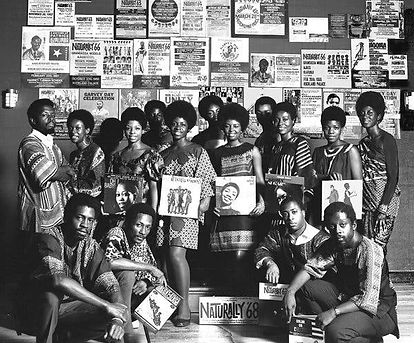
Models from the Grandassa Models agency in 1968, part of the “Black Power!” exhibition at the Schomburg Center for Research in Black Culture.
Photo by Kwame Brathwaite